Orders are handled across several panels
Your team switches between marketplace platforms, the online store, the courier system, accounting and spreadsheets.

We connect marketplace platforms, online stores, your warehouse, accounting and carriers into one orderly process. We implement an OMS, configure automation and build custom tools wherever standard integrations fall short.
Your team switches between marketplace platforms, the online store, the courier system, accounting and spreadsheets.
Updates arrive late, oversold orders come in or products get blocked for no reason.
The invoice, the label, the status change, the message to the customer and the document printing are all done by hand.
Mistakes show up in products, carriers, documents, addresses or shipping statuses.
There is no single place that shows the status, the owner of the task and the cause of the problem.
The process does not scale - every extra batch of orders creates almost proportionally more manual work.
We look for the places where technology genuinely cuts work, reduces errors or improves control over sales.
One order. More than a dozen decisions. One orderly process.
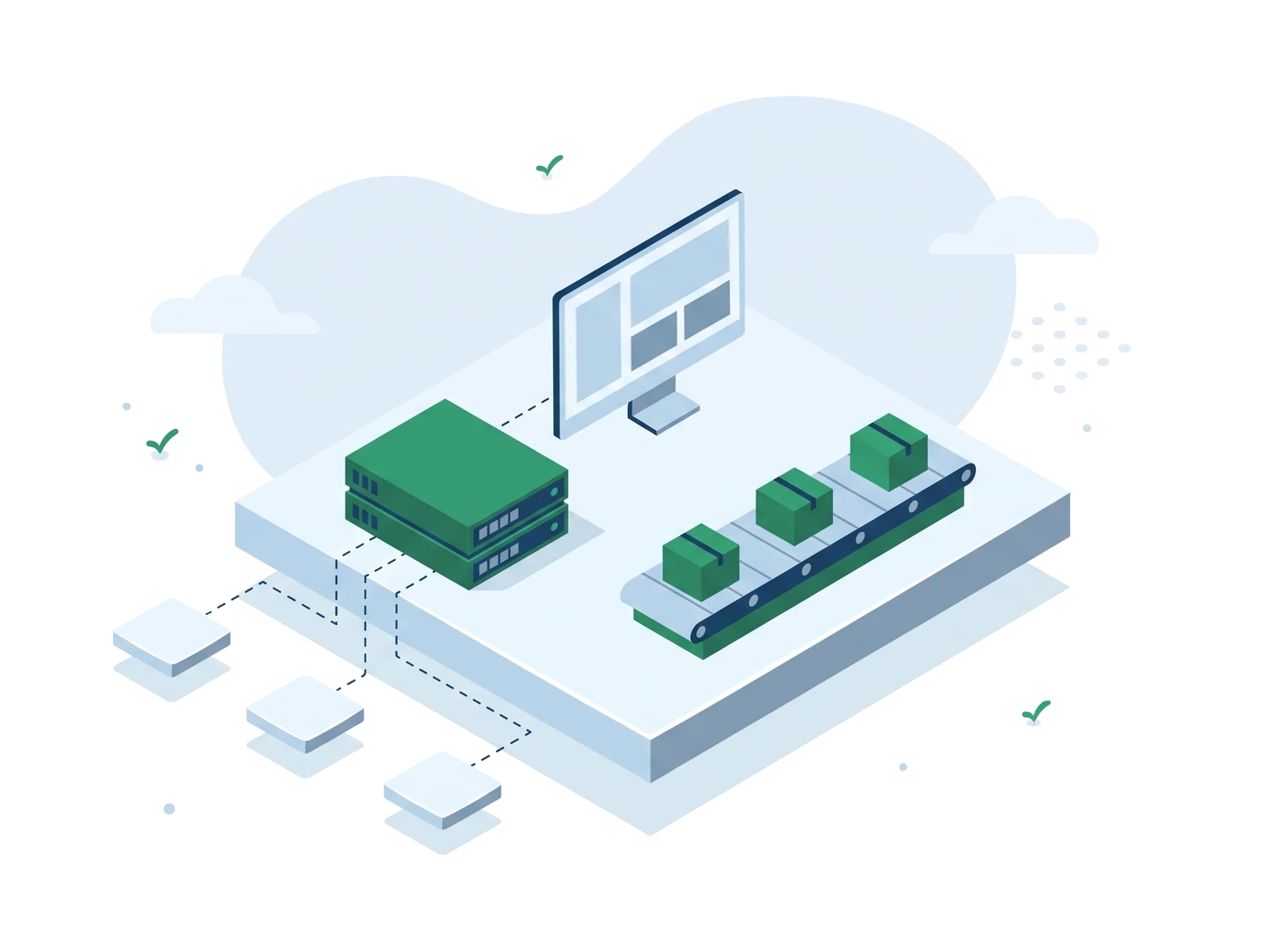
The order travels automatically from the marketplace platform or the store into one central panel.
The system checks the payment, product availability, customer details, the delivery method and any exceptions.
A carrier is selected and the label, the invoice and the warehouse documents are generated.
The picker gets a product list, and barcode scanning confirms that picking and packing are correct.
The status, the tracking number and stock levels go back to the right marketplace platforms and to the store.
Returns, complaints, cancellations and corrections go into separate, well-ordered processes.
Good automation is not about pushing every order through no matter what. We handle repeatable, safe cases automatically and route the orders that need a decision to the right person.
The result: your team does not review every order. It only deals with the ones that really need attention.
Not every company needs a full-blown OMS from day one. We match the level to your current scale.
Orders from every channel land in one panel. Stock levels and basic statuses stay in sync.
The system creates documents, shipments and messages on its own, and changes order statuses.
We roll out warehouse locations, scanning, picking, packing checks and orderly returns.
We connect the OMS with ERP, PIM, WMS and wholesalers. We add custom rules, apps, alerts and reports.
We match the right level to your current scale. We do not roll out elaborate architecture when the problem can be solved with a few well-designed rules.
First we get to know your process, your sales volume, your warehouse structure and the systems you use. Only then do we pick the tool that demands the fewest compromises.
We only recommend a specific system after the audit - matched to the scale and the specifics of your business, not the other way round.
A comprehensive platform for multichannel selling. It works well when you need advanced automation, central order handling, marketplace, shipping, a product catalogue and warehouse processes. It offers automatic actions, shipment handling, Pick&Pack, PIM and WMS, among others.
Sales channel integration and process automation. Worth considering when you need extensive price and stock synchronisation as well as warehouse and packing support. It claims over 600 integrations, advanced price management, barcode support and a Packing Assistant.
A platform especially worth considering for expansion in the CEE region and selling on local markets such as eMAG and Trendyol. It supports order centralisation, automation rules, document and shipment generation, and integrations with eMAG and Trendyol.
We are not tied to a single system. If your current tool can be sensibly improved, we will not propose a migration just to start the implementation from scratch.
We propose custom development when the solution removes a recurring cost, bridges incompatible systems or gives your company an advantage that off-the-shelf software cannot provide.
We show how the order, the product and the information flow between people and systems.
We point out the tasks that generate the most manual work, delays, errors and cost.
We check which systems to keep, which need reconfiguring and which are holding back growth.
We describe the future order flow, the roles of your team, the automatic rules and exception handling.
We select the OMS and the connections to your store, marketplace platforms, warehouse, accounting and logistics.
We split the project into stages and point to the changes that deliver the fastest result at the lowest risk.
We map the processes, systems, roles and data sources. We establish how much work and how many errors your current model generates.
We pick the system and design the statuses, rules, permissions, integrations and the way exceptions are handled.
We verify SKUs, EANs, warehouses, offer links, stock sources and the data needed for the migration.
We connect the channels, build automatic actions and create extra modules wherever they are needed.
We test standard orders, cancellations, stock shortages, payment errors, returns and service outages.
We run the process on a limited scope - one chosen market, warehouse or group of orders.
We move your team onto the new process, hand over the instructions and train them on the standard flow and the exceptions.
We analyse how the rules perform, remove redundant steps and develop the system as your sales grow.
A marketplace, a carrier, an accounting system or an API can stop responding for a while. That is why an implementation covers not only the correct path, but also the way errors are detected and handled.
An OMS is worth considering once orders arrive from several channels, stock is updated by hand or handling sales means working across multiple panels. There is no single minimum number of orders - what also matters is the complexity of the process and the number of products, warehouses, employees and markets.
It depends on the marketplace platforms, store, ERP, warehouse and carriers you use, and on the way your team works. During the audit we compare the available solutions and recommend the system that demands the fewest compromises and leaves room for further growth.
Not always. We first check whether your current solutions can stay in place and be connected to the OMS. We only recommend a migration when the system you use makes automation impossible, generates recurring errors or holds back sales growth.
It should not replace decisions that call for human judgement. The system takes over repeatable and predictable operations, while unusual orders, errors, complaints and exceptions are routed to the right people.
Yes. An implementation does not have to mean building the system from scratch. We analyse the existing configuration, automatic actions, integrations, statuses and product links, then remove the errors and simplify the process.
Yes. The scope of the integration can cover order import, price and stock updates, status handover, document handling and product data synchronisation, among others. The exact possibilities depend on the chosen system and on the interface the marketplace makes available.
Yes. The process can use barcode scanners to identify the order and confirm the products being packed. That reduces the risk of shipping the wrong variant or the wrong product.
A custom module makes sense when standard integrations do not cover an important process or require regular manual work. Before we start development, we check whether the problem can be solved by configuring the existing system.
Yes. We often start with one channel, one warehouse or part of the process. Once the solution is tested, we extend the automation to further markets, employees and areas of the business.
We analyse how the rules perform, the synchronisation errors and the cases that need manual intervention. We fine-tune and develop the system as your order volume, your channels and the way your company works change.
Book a free process audit - we will show you what can be simplified, what can be automated and how much work that wins back.
Book a free process audit